
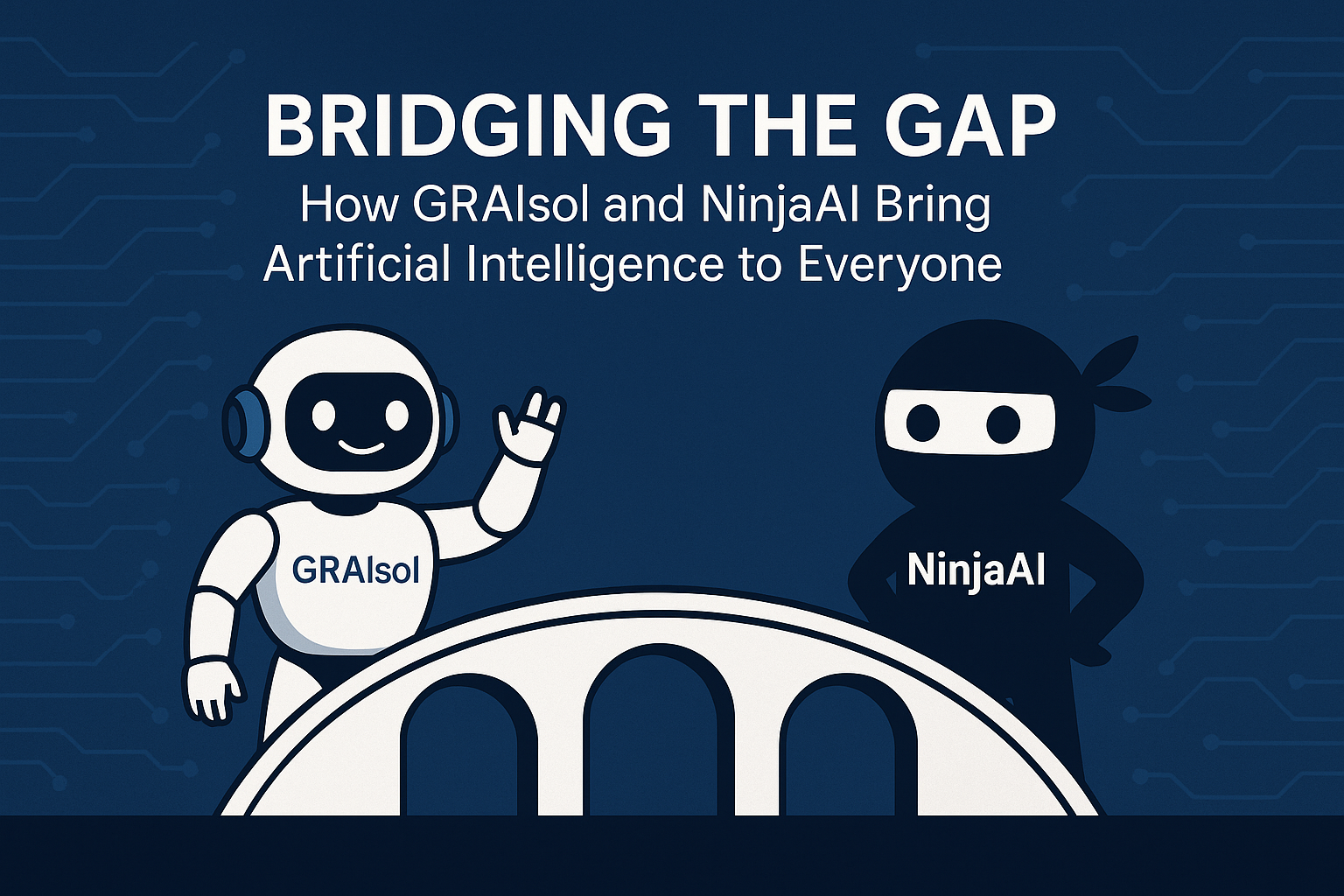

Bridging the Gap: How GRAIsol and NinjaAI Bring Artificial Intelligence to Everyone

Griffin Long, System Architect • August 2, 2025

Bridging the Gap: How GRAIsol and NinjaAI Bring Artificial Intelligence to Everyone


Opening the conversation: Why most people get stuck after saying “hi” to ChatGPT


The public launch of ChatGPT and other generative models gave everyone access to AI. Yet the typical first‑time experience is strikingly similar: you greet the tool, receive its friendly response, and then… nothing. Without clear prompts or a deeper understanding of what the technology can do, many people stall. They want help writing newsletters or summarising reports but don’t know how to ask. They dream of automating their bookkeeping or generating beautiful marketing assets but think that AI is reserved for tech giants and coders. This gap between potential and practicality keeps everyday users from leveraging artificial intelligence.


At GRAIsol, our mission is to close that gap. We build custom websites and AI‑powered SaaS platforms that make sophisticated capabilities accessible to solo founders, startups and non‑technical teams. Our expertise extends from mobile‑first website design—with SEO, lead‑generation forms and analytics built in—to AI integrations such as intelligent chatbots, automated content generation and data analysis. We don’t just build tools; we create systems that empower people to use AI confidently and productively.


Publishing this guest article on NinjaAI is a natural fit, because NinjaAI’s blog exists to help Florida businesses and ambitious professionals “dominate online” through AI‑powered marketing. Jason Wade’s team offers expertise in search engine optimisation (SEO), generative engine optimisation (GEO), prompt engineering, branding and web design. Their content teaches readers how to craft structured prompts, optimise their pages for generative search, and harness AI tools to scale content. GRAIsol and NinjaAI share a common goal: making advanced technology accessible and profitable for everyday users. This post explains how AI can transform ordinary workflows, offers practical prompts and strategies, and shows how GRAIsol’s solutions complement NinjaAI’s marketing know‑how.


AI enablement vs. AI development: two sides of the same coin


Many companies dabble in AI by installing off‑the‑shelf chatbots or auto‑completers. Those tools are helpful, but they barely scratch the surface of what artificial intelligence can achieve. AI enablement means equipping people and organisations with the skills and confidence to use AI effectively. AI development means building bespoke systems that solve real business problems. Both are crucial.

AI enablement: teaching people how to talk to machines


  • Prompt engineering for everyone – NinjaAI emphasises the importance of “AI prompt engineering,” teaching users how to craft powerful, structured prompts that generate blog content, landing pages, ad copy, emails and social posts. When you know how to ask the right questions, generative models become incredibly helpful.


  • Generative engine optimisation (GEO) – SEO isn’t enough anymore. NinjaAI encourages brands to be visible inside AI engines like ChatGPT, Google’s Generative Search, Perplexity and Gemini. Their experience shows that focusing on LLM‑first visibility can deliver leads faster than waiting months for traditional search rankings.


  • Democratising AI knowledge – The NinjaAI blog promises step‑by‑step frameworks, AI‑powered tools and real‑world examples. By demystifying AI, they empower small businesses and busy professionals to compete with enterprises who have bigger budgets.


AI development: building customized solutions that do the hard work


On the development side, GRAIsol specialises in more than just websites. We create AI‑powered SaaS platforms that integrate models like GPT‑4o and other machine‑learning tools. For example:


  • Professional business websites – our sites are mobile‑first, SEO‑optimised and designed to convert visitors into customers. They include lead‑generation forms, content management systems and performance analytics so you can track results without hiring a technical team.


  • AI‑powered SaaS platforms – these custom applications include user authentication, billing systems, scalable cloud architecture and real‑time processing. They are the backbone of products like BrandSnap, which generates complete brand kits and marketing materials in under two minutes using GPT‑4o; and PromptFlyers, which lets anyone create professional event flyers in 30 seconds by merely writing a description. The ability to generate pro‑quality assets with no design skills shows how AI can democratise creativity.


  • Website enhancement and AI features – we add AI chatbots, lead qualification systems, content generation tools and analytics to existing sites. These features reduce manual labour and make it natural for visitors to interact with your brand.


  • Business process automation – our expertise in custom automation and integration with tools like Zapier, databases and APIs helps streamline repetitive tasks. From invoice processing to lead follow‑up, AI can free your team to focus on high‑value work.


  • AI capability mastery – we don’t stop at integration. GRAIsol provides content generation, data analysis, customer intelligence, process automation, quality assurance and continuous‑learning systems. These capabilities give your platform the ability to learn and improve over time.


When you combine AI enablement and AI development, you empower people to imagine what’s possible and then equip them with the tools to make it happen.


Five practical ways AI can help regular people today


1. Create stunning marketing assets without designers


Most small‑business owners and community organisers can’t afford professional graphic designers. AI closes that gap. Tools like GRAIsol’s PromptFlyers generate high‑resolution flyers in under a minute. You simply describe your event (e.g., “Farmers market this Saturday with live music and fresh produce”), select a style and download a polished flyer ready for print or social media. This saves hours of manual design and hundreds of dollars per campaign. It also ensures your brand looks consistent across digital and physical channels.


Another example is BrandSnap, which creates complete brand kits—logos, colour palettes, typography and social graphics—within minutes. By leveraging AI, even non‑technical users can build a professional brand identity that stands out.


2. Automate repetitive business tasks


AI isn’t just about content creation. Many administrative tasks can be automated. For instance, a ChatGPT agent can connect to your email, classify incoming messages and create support tickets in your CRM, drafting polite responses automatically. Simple automations like sorting invoices, updating spreadsheets or generating weekly status reports free up time for strategic thinking. When combined with GRAIsol’s custom automations and integration expertise, even small companies can build workflows that rival enterprise operations.


3. Unlock insights from your data


Business owners accumulate data—from website analytics and sales histories to customer surveys and social‑media interactions. Yet data is only valuable when you can interpret it. GRAIsol’s AI models provide intelligent insights from business data and user behavior. We build dashboards that highlight which marketing channels convert best, which customer segments are most profitable, and how to optimise your operations. When AI does the heavy lifting, you can make informed decisions without hiring a data scientist.


4. Build smarter customer experiences


Consumers expect personalised, instantaneous responses. Integrating AI chatbots into your website or mobile app makes this possible. Our systems use GPT‑powered language models to handle frequently asked questions, qualify leads and recommend products or services. They also learn from interactions, improving accuracy over time. By coupling these bots with NinjaAI’s expertise in customer prompt engineering, you ensure the conversation sounds human and drives conversions.


5. Focus your marketing where it matters


Traditional SEO can take months to show results, and online advertising budgets may be prohibitive for small businesses. NinjaAI’s generative engine optimisation (GEO) strategy helps your content appear directly in AI search results on platforms like ChatGPT, Perplexity, Gemini and Siri. For example, adding short Q&A sections to product pages and building an AI‑specific sitemap improved one startup’s LLM visibility dramatically, leading to a higher conversion rate. When you pair this visibility strategy with GRAIsol’s AI‑powered content and websites, your brand becomes discoverable where people actually search.


How to get started: prompts and workflows you can try today


To make AI approachable, here are a few step‑by‑step prompts and workflows. Modify the brackets to fit your business, and run them in ChatGPT or any GPT‑powered tool.


Workflow 1: Generate a content calendar using AI


  • Research trending topics and competitor content.


Use a prompt like: “Research the top trending topics in [your industry] over the last month. Analyse competitor articles for keyword frequency, backlinks and engagement. Create a four‑week content calendar with article titles, recommended keywords, publish dates and brief summaries.”


This prompt is inspired by NinjaAI’s AI content and SEO workflow. The agent will return a complete editorial plan, saving hours of manual research.


  • Transform the calendar into a series of blog posts.


  • Ask: “For each article title in the calendar, draft an outline (intro, headings, bullet points) and suggest relevant images or stats to include.”


This ensures your posts are well structured and ready to write or delegate to a writer.


  • Optimize for generative search.


  • After drafting, use a prompt like: “Rewrite this blog post to answer the question ‘[specific question your audience asks]’ in 40 words or less. Include this in a Q&A section at the end.”


Short Q&As help your content surface in AI engines like Perplexity.


Workflow 2: Automate customer support triage


  • Connect email and CRM. Use a ChatGPT agent or integration service (Zapier, Make) to link your email and CRM system.


  • Categorise support requests. Create a prompt such as:


“For each new customer email, categorize it as billing, bug, feature request, or feedback. Summarize the key details and record the ticket in [CRM]. Draft a polite response.” 


  • Review and send. Always review AI‑drafted responses before sending. Over time, the model learns your brand voice and can accelerate ticket resolution by 2–3x.


Workflow 3: Create an automated design asset


  • Describe your event or product. Use this in PromptFlyers or any AI design tool:

“Generate a flyer for [event name] on [date] at [location]. The design should be [style: minimalist/retro/modern], include [key information: speakers, sponsors], and use [colors or brand style].”


  • Preview and edit. The tool generates a high‑resolution design instantly. You can then adjust wording or swap images if needed.


  • Download and share. With professional graphics ready, post to social media, print flyers or embed them in newsletters.


  • Workflow 4: Build your own AI assistant


  • Identify a repetitive task (e.g., compiling daily sales summaries).


  • Outline the steps needed to complete the task manually (gather data, summarise, email to stakeholders).


  • Create a prompt that instructs the AI to perform those steps.


  • Integrate with automation tools like Zapier or directly call GRAIsol’s APIs to schedule the workflow. Many tasks can be accomplished through the ChatGPT agent’s ability to use connectors.


  • Refine based on results. Adjust prompts and automation triggers until the process is reliable.


Why Florida businesses are uniquely positioned to benefit


Both GRAIsol and NinjaAI operate from Florida, serving clients across Orlando, Miami, Tampa and beyond. This region’s vibrant mix of family‑owned service providers, fast‑scaling startups and local organisations means there is a huge opportunity to use AI to level the playing field. Whether you’re a dentist in Sarasota, a church in Winter Haven, a lawyer in Winter Park or a franchise expanding across Central Florida, NinjaAI’s blog highlights case studies and industry‑specific insights. Pairing those marketing strategies with GRAIsol’s development expertise means you can be first in your market to leverage AI for both visibility and operations.


Bringing it all together: from curiosity to capability


When a friend opens ChatGPT and doesn’t know what to type, that’s not a failure of the user—it’s a failure of the AI community to provide accessible guidance and tools. At GRAIsol, we believe that AI should empower, not intimidate. By partnering with NinjaAI’s team, we’re showing how the combination of enablement (teaching people to use AI through prompt engineering and GEO) and development (building custom AI‑powered platforms) can transform any organisation.


If you’re ready to go beyond “hello” and start leveraging AI to build systems, design stunning assets, automate processes and grow your brand, reach out at GRAIsol.com. GRAIsol offers free consultations and works with you through our proven four‑phase process: strategy and planning, MVP development, scaling, and launch. Whether you need a converted‑focused website, an AI‑powered platform or a simple automation that saves you a few hours a week, our goal is to deliver custom solutions tailored to your business. We also invite you to explore NinjaAI’s blog for marketing strategies that will help you stand out in search engines and generative AI platforms.

To see AI in action, check out PromptFlyers.com and experiment with generating a flyer for your next event. You’ll experience firsthand how AI can turn a few words into a polished, professional graphic. When combined with GRAIsol’s platforms and NinjaAI’s marketing frameworks, this is just a glimpse of what’s possible.


Let’s close the gap together. With the right prompts, platforms and partners, anyone—no matter their background—can harness the power of AI.


-Griffin Long

GRAIsol

Digital brain with circuit patterns radiating light, processing data represented by documents and cubes.
By Jason Wade December 17, 2025
Google's Gemini 3 Flash: Google launched Gemini 3 Flash, a faster and more efficient version of the Gemini 3 model.

Ninjas in black outfits are posed in front of a red and yellow explosion.
By Jason Wade December 17, 2025
Google’s statement that “SEO for AI is still SEO” is technically accurate but strategically incomplete, and misunderstanding that gap is now one of the....
By Jason Wade December 17, 2025
OpenAI's New Image Generation Model: OpenAI released a new AI image model integrated into ChatGPT, enabling more precise image editing and generation speeds up to four times faster than previous versions. This update emphasizes better adherence to user prompts and detail retention, positioning it as a competitor to Google's Nano Banana model. NVIDIA Nemotron 3 Nano 30B: NVIDIA unveiled the Nemotron 3 Nano, a 30B-parameter hybrid reasoning model with a Mixture of Experts (MoE) architecture (3.5B active parameters). It supports a 1M token context window, excels in benchmarks like SWE-Bench for coding and reasoning tasks, and runs efficiently on ~24GB RAM, making it suitable for local deployment. AI2's Olmo 3.1: The Allen Institute for AI (AI2) released Olmo 3.1, an open-source model with extended reinforcement learning (RL) training. This iteration improves reasoning benchmarks over the Olmo 3 family, advancing open-source AI for complex tasks. Google Gemini Audio Updates: Google rolled out enhancements to its Gemini models, including beta live speech-to-speech translation, improved text-to-speech (TTS) in Gemini 2.5 Flash/Pro, and native audio updates for Gemini 2.5 Flash. These focus on real-time communication and natural language processing. OpenAI Branched Chats and Mini Models: OpenAI introduced branched chats for ChatGPT on mobile platforms, along with new mini versions of realtime, text-to-speech, and transcription models dated December 15, 2025. These aim to enhance real-time voice capabilities. Google Workspace AI Tools: Google launched several AI updates, including Gen Tabs (builds web apps from browser tabs), Pomelli (turns posts into animations), and upgrades to Mixboard, Jules, and Disco AI for improved productivity and creativity. New Papers Prioritizing AI/ML-focused submissions from the past day: Nemotron-Cascade: Scaling Cascaded Reinforcement Learning for General-Purpose Reasoning Models by Boxin Wang et al. (NVIDIA): Explores scaling cascaded RL to build versatile reasoning models, with potential for open-source impact in agentic AI. LongVie 2: Multimodal Controllable Ultra-Long Video World Model by Jianxiong Gao et al.: Introduces a controllable multimodal world model for generating ultra-long videos, advancing video synthesis and simulation. Towards Effective Model Editing for LLM Personalization by Baixiang Huang et al.: Proposes techniques to edit large language models (LLMs) for personalization, addressing challenges in adapting models to individual users. Grab-3D: Detecting AI-Generated Videos from 3D Geometric Temporal Consistency by anonymous authors: Develops a detection method for AI-generated videos by checking 3D geometric consistency, crucial for combating deepfakes. Link: https://arxiv.org/abs/2512.08219. MindDrive: A Vision-Language-Action Model for Autonomous Driving via Online Reinforcement Learning by Haoyu Fu et al.: Presents an end-to-end model for autonomous driving that integrates vision, language, and actions with online RL. Jason Wade Founder & Lead, NinjaAI I build growth systems where technology, marketing, and artificial intelligence converge into revenue, not dashboards. My foundation was forged in early search, before SEO became a checklist industry, when scaling meant understanding how systems behaved rather than following playbooks. I scaled Modena, Inc. into a national ecommerce operation in that era, learning firsthand that durable growth comes from structure, not tactics. That experience permanently shaped how I think about visibility, leverage, and compounding advantage. Today, that same systems discipline powers a new layer of discovery: AI Visibility. Search is no longer where decisions begin. It is now an input into systems that decide on the user’s behalf. Choice increasingly forms inside answer engines, map layers, AI assistants, and machine-generated recommendations long before a website is ever visited. The interface has shifted, but more importantly, the decision logic has moved upstream. NinjaAI exists to place businesses inside that decision layer, where trust is formed and options are narrowed before the click exists. At NinjaAI, I design visibility architecture that turns large language models into operating infrastructure. This is not prompt writing, content output, or tools bolted onto traditional marketing. It is the construction of systems that teach algorithms who to trust, when to surface a business, and why it belongs in the answer itself. Sales psychology, machine reasoning, and search intelligence converge into a single acquisition engine that compounds over time and reduces dependency on paid media. If you want traffic, hire an agency. If you want ownership of how you are discovered, build with me. NinjaAI builds the visibility operating system for the post-search economy. We created AI Visibility Architecture so Main Street businesses remain discoverable as discovery fragments across maps, AI chat, answer engines, and machine-driven search environments. While agencies chase keywords and tools chase content, NinjaAI builds the underlying system that makes visibility durable, transferable, and defensible. AI Visibility Architecture is the discipline of engineering how a business is understood, trusted, and recommended across search engines, maps, and AI answer systems. Unlike traditional SEO, which optimizes pages for rankings and clicks, AI Visibility Architecture structures entities, context, and authority so machines can reliably surface a business inside synthesized answers. NinjaAI designs and operates this architecture for local and Main Street businesses. This is not SEO. This is not software. This is visibility engineered as infrastructure.